Shea Moisture Olive Oil Baby Villa Rica Ga

A container of shea butter as sold in Republic of benin

Seeds of a shea tree — raw materials for oil product
Shea butter (, , or ; Bambara: sìtulu ߛߌ߮ߕߎߟߎ [one]) is a fatty extracted from the nut of the African shea tree (Vitellaria paradoxa).[ii] It is ivory in color when raw and commonly dyed xanthous with borututu root or palm oil. It is widely used in cosmetics as a moisturizer, salvage or balm. Shea butter is edible and is used in nutrient preparation in some African countries.[3] Occasionally, shea butter is mixed with other oils equally a substitute for cocoa butter, although the taste is noticeably different.[4] [5]
The English discussion "shea" comes from s'í , the tree'due south name in Bambara.[6] It is known by many local names, such every bit kpakahili in the Dagbani linguistic communication, taama in the Wali language, kuto in Twi, kaɗe or kaɗanya in Hausa, òkwùmá in the Igbo language, òrí in the Yoruba language, karité in the Wolof language of Senegal,[vii] and ori in some parts of Westward Africa and many others.[ citation needed ]
History [edit]
The common name is shísu ߛ߭ߌ߭ߛߎ (lit. "shea tree") in the Bambara linguistic communication of Mali. This is the origin of the English language word, one pronunciation of which rhymes with "tea" , although the pronunciation (rhyming with "24-hour interval") is common, and is listed second in major dictionaries. The tree is called ghariti in the Wolof language of Senegal, which is the origin of the French name of the tree and the butter, karité .
The shea tree grows naturally in the wild in the dry savannah belt of West Africa from Senegal in the w to Sudan in the due east, and onto the foothills of the Ethiopian highlands. It occurs in 21 countries across the African continent, namely Benin, Burkina Faso, Republic of cameroon, Central African Democracy, Chad, Federal democratic republic of ethiopia, Eritrea, Republic of ghana, Guinea Bissau, Cote d'ivoire, Mali, Niger, Nigeria, Senegal, Sierra Leone, South Sudan, Sudan, Togo, Uganda, Autonomous Congo-brazzaville, Republic of kenya and Guinea.
A testa constitute at the site of the medieval village of Saouga is evidence of shea butter production by the 14th century.[8] The butter was being imported into Britain by 1846.[9]
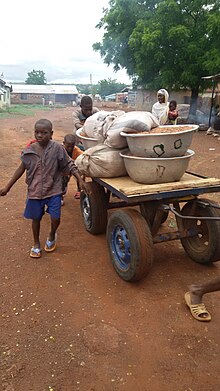
Children transporting crushed shea nuts in Jisonaayili, Ghana

Wala women selling shea butter in Ghana

Traditional preparation of shea butter in Republic of mali

A young lady selling shea butter in Ghana.
Composition and properties [edit]
Shea butter extract is a complex fatty that in improver to many nonsaponifiable components (substances that cannot exist fully converted into soap by treatment with alkali) contains the following fatty acids: oleic acid (40–60%), stearic acid (xx–50%), linoleic acid (3–11%), palmitic acrid (2–9%), linolenic acid (<1%) and arachidic acrid (<1%).[ten]. It likewise contains the vitamins A, E and F.
Shea butter melts at body temperature. Proponents of its use for pare care maintain that it absorbs rapidly into the skin, acts equally a "refatting" agent, and has good h2o-binding properties.[eleven]
Uses [edit]
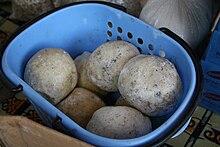
Shea butter is mainly used in the cosmetics industry for skin- and hair-related products (lip gloss, lip stick, pare moisturizer creams and emulsions, and hair conditioners for dry and breakable pilus).[12] [thirteen] It is too used by lather makers and massage oil manufacturers, typically in small amounts, because information technology has enough of unsaponifiables, and college amounts result in a softer soap that has less cleaning ability. Some artisan lather makers apply shea butter in amounts to 25% – with the European Union regulating the maximum use around 28%, but it is rarely the case in commercially produced soap due to its high cost compared to oils like palm oil or pomace (olive oil). It is an excellent emollient for dry skin.[ citation needed ] No evidence shows it is a cure, but information technology alleviates the hurting associated with tightness and itching.
In some African countries such equally Benin, shea butter is used for cooking oil, as a waterproofing wax, for hairdressing, for candle-making, and every bit an ingredient in medicinal ointments. Information technology is used past makers of traditional African percussion instruments to increase the immovability of woods (such as carved djembe shells), dried calabash gourds, and leather tuning straps.[ citation needed ]
Medicinal [edit]
Shea butter is sometimes used as a base for medicinal ointments. Some of the isolated chemical constituents are reported to have antimicrobial, anti-inflammatory,[fourteen] emollient, and humectant backdrop.[ citation needed ] Shea butter has been used as a sunblocking lotion[15] with an estimated SPF of 3–four and some of its components "have limited capacity to absorb ultraviolet radiations".[iv]
In Ghana, shea butter, locally known equally Kpakahili (Eng. trans. raw cream) in Dagbani, nkuto (Akan) or nku (Ga), is either used as a food product or applied every bit balm to protect the peel during the dry Harmattan flavor. The shea nut tree itself is called tááŋà (pl. táánsì) and the fruit is chosen táánì (pl. támá). The electric current northern regional capital Tamale derives its name from a combination of the words "tama" and "yili", meaning "the boondocks of shea fruits".
In Nigeria, shea butter is used for the management of sinusitis and relief of nasal congestion.[sixteen] Information technology is massaged into joints and other parts of the body where pain occurs.[17]
Nomenclature [edit]
The United States Bureau for International Development and other companies[18] have suggested a classification organization for shea butter, separating it into five grades:
- A (raw or unrefined, extracted using h2o)
- B (refined)
- C (highly refined and extracted with solvents such every bit hexane)[xix]
- D (lowest uncontaminated grade)
- Due east (with contaminants).
Commercial grades are A, B, and C. The color of raw (class A) butter ranges from cream (like whipped butter) to grayish yellow. Information technology has a nutty aroma which is removed in the other grades. Course C is pure white.[xx] [21] While the level of vitamin content can be affected by refining, upwards to 95% of vitamin content can exist removed from refined grades (i.eastward., course C) of shea butter while reducing contamination levels to undetectable levels.[22] [23]
See also [edit]
- Shea nut and butter product in Burkina Faso
- Shea Yeleen, a social enterprise that trains women-owned shea butter cooperatives.
- African black lather, a West African soap traditionally prepared with shea butter.
References [edit]
- ^ "S". Manding (Bambara/Jula) Dictionary. An ka taa. Retrieved May 29, 2021.
{{cite encyclopedia}}: CS1 maint: url-status (link) - ^ Alfred Thomas (2002). "Fats and Fatty Oils". Ullmann's Encyclopedia of Industrial Chemistry. Weinheim: Wiley-VCH. doi:10.1002/14356007.a10_173. ISBN978-3527306732.
- ^ National Research Council (2006-10-31). Lost Crops of Africa: Volume II: Vegetables (2006). ISBN978-0-309-10333-6.
- ^ a b E. T. Masters, J. A. Yidana and P. N. Lovett (2004). "Reinforcing sound management through trade: shea tree products in Africa".
- ^ Fold, N. 2000. (2013-01-14). "A matter of practiced taste? Quality and the construction of standards for chocolate in the European Matrimony. Cahiers d'Economie et Sociologie Rurales, 55/56: 92–110" (PDF).
- ^ "Reference.com Dictionary Entry". Retrieved 25 August 2012.
- ^ Goreja, W. G. (2004). "2". Shea Butter: The Nourishing Properties of Africa's Best-Kept Natural Beauty Secret. TNC International. p. five. ISBN9780974296258.
- ^ *Neumann, 1000., et al. 1998. Remains of woody plants from Saouga, a medieval west African village. Vegetation History and Archaeobotany, 7:57-77.
- ^ "Shea Butter". Stamford Mercury - Friday 28 Baronial 1846. p. 2.
- ^ Davrieux, F., Allal, F., Piombo, Grand., Kelly, B., Okulo, J. B., Thiam, 1000., Diallo, O. B. & Bouvet, J.-Thou. (2010) (2010). "Near Infrared Spectroscopy for Loftier-Throughput Characterization of Shea Tree (Vitellaria paradoxa) Nut Fatty Profiles. Journal of Agronomical and Food Chemistry, 58, 7811-7819". Journal of Agronomical and Food Chemistry. 58 (13): 7811–7819. doi:ten.1021/jf100409v. PMID 20518501.
{{cite journal}}: CS1 maint: multiple names: authors list (link) - ^ Hemat, R. A. S. (2003). Principles of Orthomolecularism. Urotext. p. 160. ISBN9781903737057.
- ^ "African Shea Butter Benefits". Retrieved eight October 2017.
- ^ "Shea Butter. How Good is It for Your Trunk?".
- ^ Akihisa, T.; Kojima, Northward.; Kikuchi, T.; Yasukawa, K.; Tokuda, H.; Masters, E. T.; Manosroi, A.; Manosroi, J. (2010). "Anti-inflammatory and chemopreventive furnishings of triterpene cinnamates and acetates from shea fat". Journal of Oleo Scientific discipline. 59 (vi): 273–eighty. doi:ten.5650/jos.59.273. PMID 20484832.
- ^ "22 Reasons to Apply Shea Butter". Healthline. 2018-eleven-27. Retrieved 2021-03-22 .
- ^ Tella, A, Br (1979). "Preliminary studies on nasal decongestant activity from the seed of the shea butter tree, Butyrospermum parkii". J Clin Pharmacol. vii (5): 495–497. doi:x.1111/j.1365-2125.1979.tb00992.10. PMC1429586. PMID 89854.
{{cite journal}}: CS1 maint: multiple names: authors list (link) - ^ "Huge potential for Shea in Nigeria". World Agroforestry | Transforming Lives and Landscapes with Copse . Retrieved 2020-05-30 .
- ^ Us Agency For International Development, October 2006. "Buying and Selling Shea Butter: A Marketing Manual for West Africa" (PDF).
- ^ "Shea Butter Processing". GOYUM. 2021-05-19. Retrieved 2021-07-09 .
{{cite web}}: CS1 maint: url-status (link) - ^ "What grade is your shea butter?". Vermont Soap. 2016-ten-31. Retrieved 2020-05-thirty .
- ^ "CLASSIFICATION AND USES OF SHEA BUTTER | Belvyna Global Nigeria Limited". www.belvynaglobal.com. 2016-04-12. Retrieved 2016-04-21 .
- ^ Nahm, HEE. "QUALITY CHARACTERISTICS OF WEST AFRICAN SHEA BUTTER".
- ^ "CLASSIFICATION AND USES OF SHEA BUTTER | Belvyna Global Nigeria Limited". world wide web.belvynaglobal.com. 2016-04-12. Retrieved 2016-04-21 .
 | Wait up shea butter in Wiktionary, the costless dictionary. |
Source: https://en.wikipedia.org/wiki/Shea_butter
0 Response to "Shea Moisture Olive Oil Baby Villa Rica Ga"
Post a Comment